
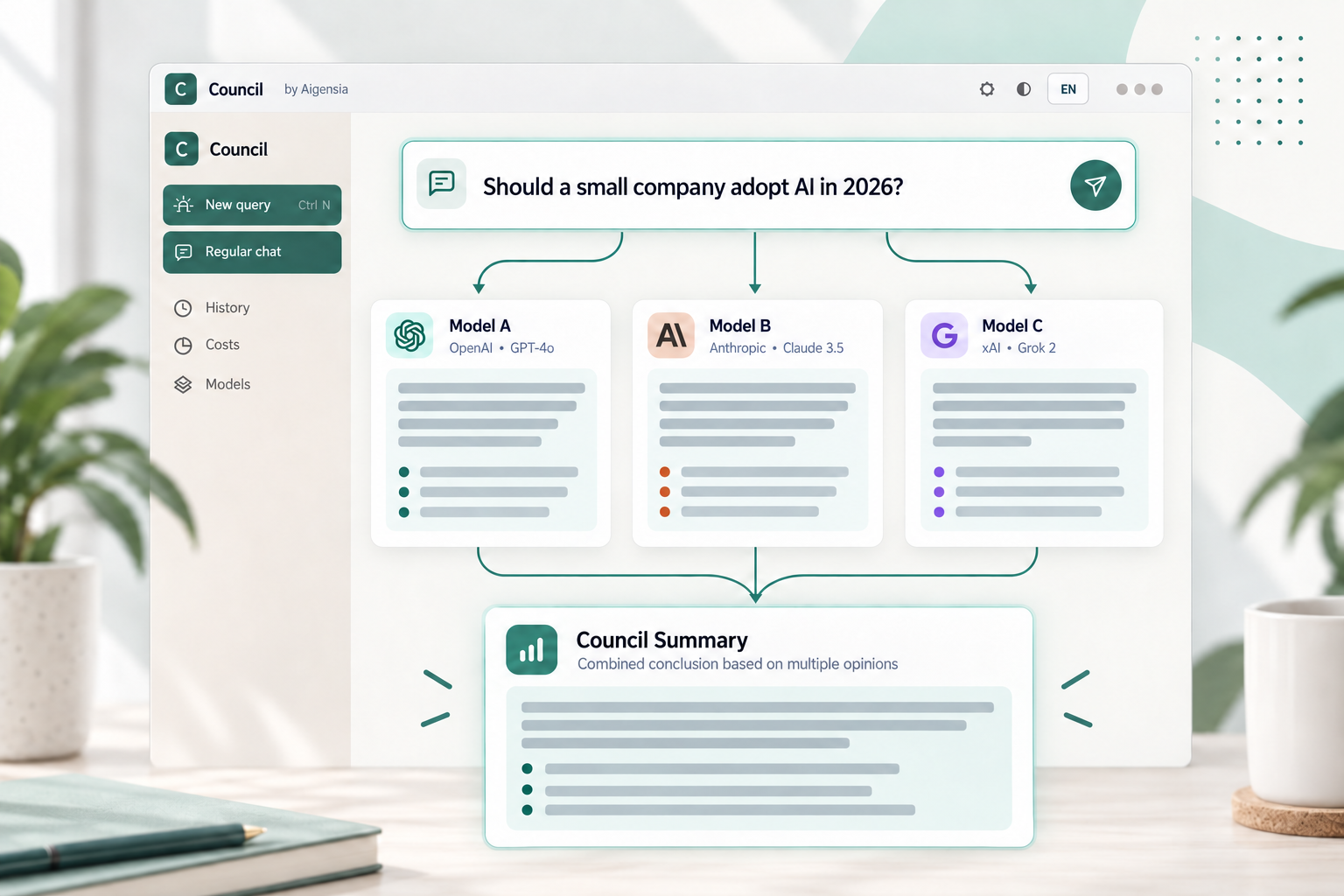
When you use AI for important tasks, one problem becomes clear: different models may assess the same question in different ways. One may suggest a good solution but miss a risk. Another may notice an error. A third may offer a completely different approach.
That is how we came to build Council, a small Windows application that gathers several independent opinions and lets us compare them in one place.
Why we built it
Sometimes we need more than a single model's answer. We want a second opinion when reviewing a project architecture, looking for weak points in a solution, or analysing an idea or a piece of code.
Opening several AI services, paying for separate subscriptions, copying the same request into each one and then comparing the answers by hand is inconvenient. Council handles this with a single request.
How it works
The workflow is simple: one question → several models → comparison → conclusion
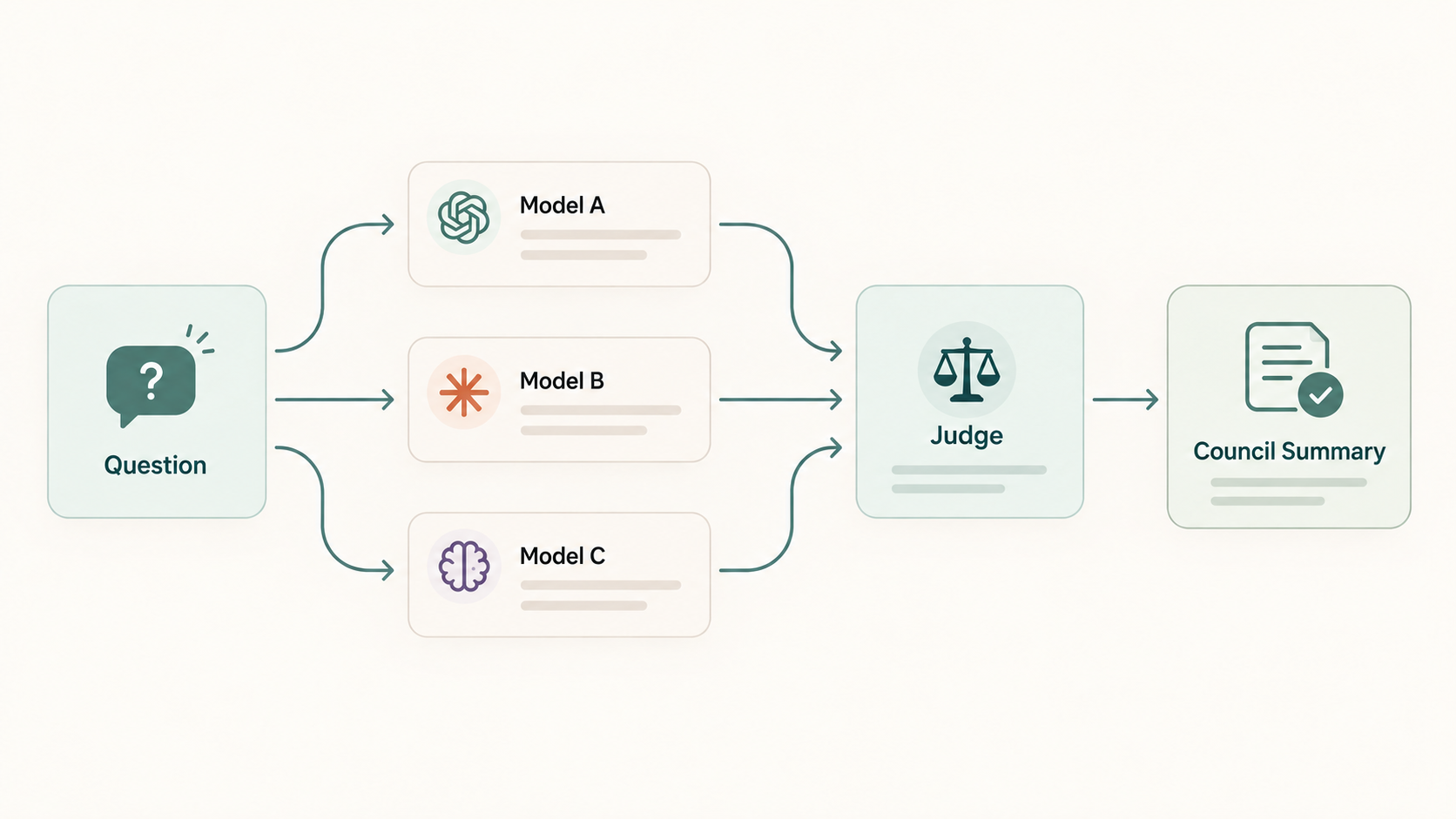
We choose the models and send the request. Each model answers independently.
We can then:
- read each answer separately;
- compare the arguments;
- identify disagreements;
- ask another model to act as a critic;
- produce a combined conclusion.
The aim is not to make five models write roughly the same answer. It is to look at the problem from several different angles.
Why OpenRouter
Council uses the OpenRouter API. It provides access to models from different developers through one interface, so we do not have to connect each provider separately.
This is useful for both development and testing: We can quickly replace one model with another and see whether the result changes. Separate subscriptions to every AI service are not required; We pay only for the API usage generated by the requests.
How the comparison works
Council supports several scenarios.
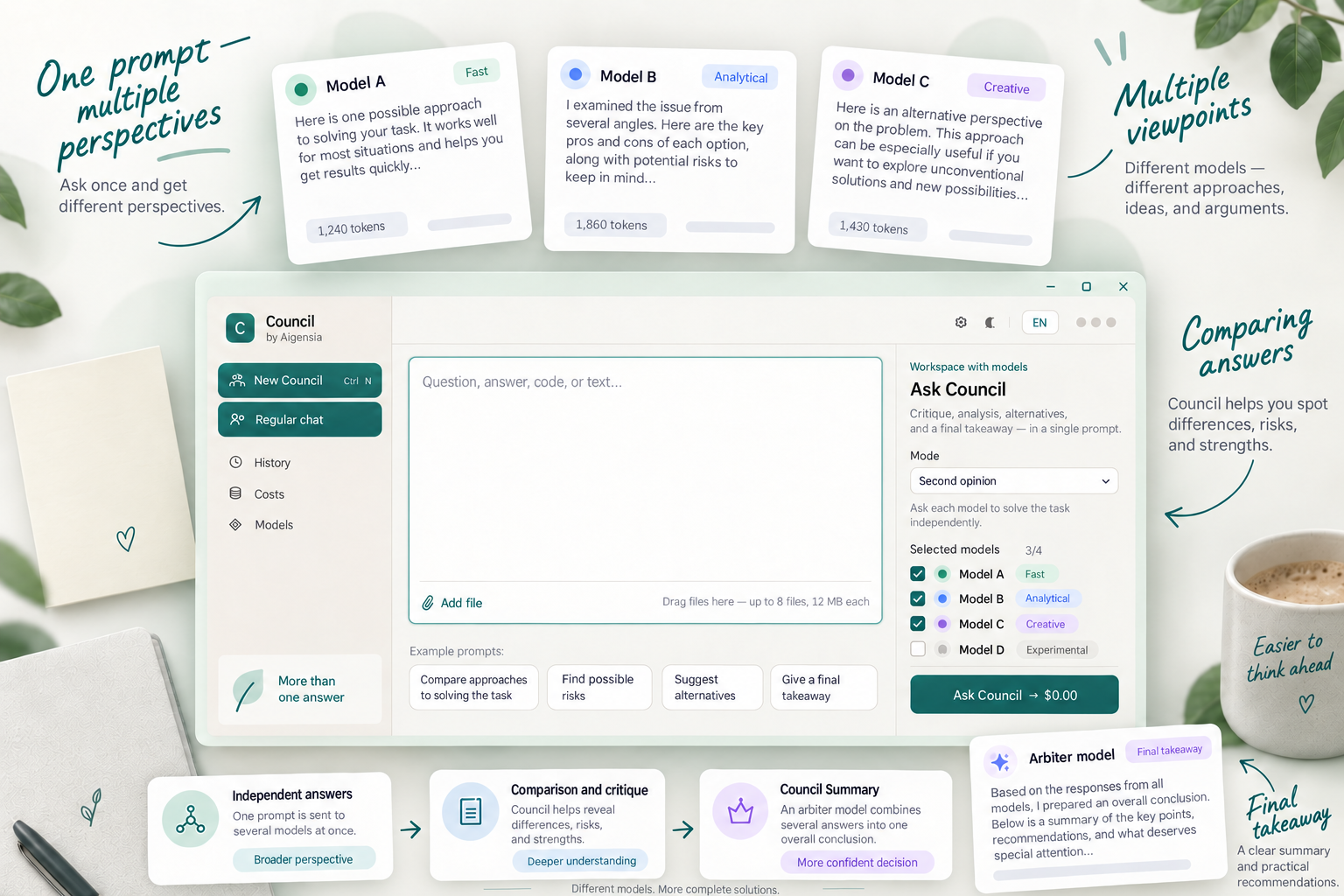
- Second opinion — collect independent answers to the same question.
- Critique — ask one model to examine another model's answer and identify weak points.
- Alternatives — collect different ways of solving the problem.
A separate model can then act as the judge: it reviews all the answers and prepares a combined Council conclusion. This conclusion is not treated as automatically correct. Council is still an analysis tool, not a replacement for human review.
Where it is useful
Council is most useful when there is no single obvious answer:
- designing a system;
- reviewing code;
- identifying risks;
- comparing technical approaches;
- examining a business idea;
- checking a proposed solution before implementation.
There is little value in running several models for a simple task. For a more difficult decision, however, an additional perspective may be more useful than another long answer from the same model.
Limitations
More models do not automatically produce a better result. Several models can make the same mistake. The judge can also reach the wrong conclusion, and every additional request increases the API cost.
We therefore see Council not as a machine that produces correct answers, but as a practical way to check an idea from several sides.
Sometimes one model is enough. Sometimes a second opinion helps. And sometimes it makes sense to bring together a small council.